Blog

Cancel
  • Tuesday’s Profile. In #diensttalk, our employees offer a glimpse into their work and share what makes their jobs special. Natalia Beshchasna works on biofunctional materials and point-of-care diagnostics at the IKTS site in Dresden-Klotzsche. She talks about the topics she is working on in the research group of the same name and how international both the team and the projects are.

    more info
  • Nanoporous ceramic membranes, e.g., for tritium recovery and recycling.
    © Fraunhofer IKTS

    Fusion research is a major global project with ambitious goals: controlled nuclear fusion is to be established as a virtually inexhaustible, safe, and climate-friendly energy source. After decades of intensive basic research, demonstration plants and initial commercial concepts are increasingly coming into focus.

    more info
  • Germany's bridges are ailing – it is therefore appropriate to continuously monitor their condition using sensors. Continuous sensor monitoring can also make sense for other infrastructure such as offshore telecommunications, pipelines, and wind turbines. Researchers at Fraunhofer IKTS are developing the corresponding sensors and procedures.

    more info
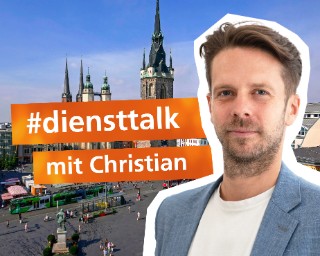
  • Tuesday's portrait. At #diensttalk, our employees give a little insight into their work and reveal the vision that drives them. Christian Klöppelt works at the IKTS site in Halle (Saale) on economic and ecological assessments of technologies and systems. He explains the exciting topics he is working on in the “Economic Analysis and Sustainability” working group and why he believes science communication is so important.

    more info
  • Our Tuesday feature: In the #diensttalk, our employees give a little insight into their work and reveal the vision that drives them. Hans-Jürgen Friedrich has been working on issues relating to the treatment of mine water using electrochemical processes for around 30 years. He tests purification technologies in the depths of the Ehrenfriedersdorf tin mine – an opportunity for the region and the environment.

    more info
  • © Fraunhofer IKTS

    Since this year, the Center for Economics and Management of Technologies (CEM), based in Halle (Saale), has been integrated as a new structural unit at Fraunhofer IKTS. In this interview, its director, Dr. Daniela Pufky-Heinrich, and the deputy director of Fraunhofer IKTS, Prof. Dr. Michael Stelter, provide an insight into the future collaboration.

    more info
  • Author / video: Fanny Pohontsch and Andrea Gaal / 2024

    #diensttalk with Dr.-Ing. Christiane Schuster about fine mechanics and nanoscale manufacturing

    August 20, 2024

    © Fraunhofer IKTS

    Our Tuesday feature: In the #diensttalk, our employees give a little insight into their work and reveal the vision that drives them. Christiane Schuster works on optical testing methods and nanosensor technology at the IKTS site in Dresden-Klotzsche. As head of the working group of the same name, she explains what lies behind this and reveals her personal research highlights to date. We also find out what she is most passionate about.

    more info
  • Author: Fanny Pohontsch / 2024

    Cultivating plants in a controlled environment

    June 20, 2024

    © Fraunhofer IKTS

    People at Fraunhofer IKTS are driven by the aim to develop holistic economical and sustainable systems as well as services for practical applications. They work together across various disciplines to gain insight into the complex questions of our time, and drive innovation.

    more info
  • Author: Fanny Pohontsch / 2024

    Carbon in the cycle

    June 19, 2024

    © Fraunhofer IKTS

    Carbon (or simply: C) has a bad reputation. At the same time, carbon is everywhere. It is the atom of life and shapes our entire economy. Carbon is part of our DNA, the foods we eat, and the products we use every day. Carbon is part of the fuels that power our vehicles and factories or heat our homes, and the materials we use to build our cities. In industry, carbon is both a source of energy and a raw material – all of organic chemistry and the downstream added value, including the building materials and plastics industries, is based on carbon.

    more info