
Economic evaluation of CCU/CCS technologies

Focus topic

CCU/CCS (Carbon Capture and Utilization/Storage) technologies aim to capture CO2 from industrial waste gases and use it as a raw material or store it geologically.  This makes it possible to avoid CO2 emissions and at the same time expand the raw material base by replacing fossil carbon sources.

Fraunhofer IKTS takes numerous factors into account in its techno-economic evaluation of projects to capture CO2, including

  • Avoidance of emission costs (in the EU ETS)
  • Proceeds from the sale of CO2 as a raw material
  • Costs for CO2 capture and transportation (investment and operating costs)
  • Perspective: certificates for CO2 removal (negative emissions)

The following example shows the techno-economic assessment of CO2 capture at a waste incineration plant using amine scrubbing. The following four scenarios were considered:

SCENARIO Energy prices Emission costs
Low (Electricity: 50 €/MWh, Heating: 12 €/GJ) High (130 €/t CO2)
High (Electricity: 120 €/MWh, Heating: 24 €/GJ) High (130 €/t CO2)
Low (Electricity: 50 €/MWh, Heating: 12 €/GJ) Low (80 €/t CO2)
High (Electricity: 120 €/MWh, Heating: 24 €/GJ) Low (80 €/t CO2)
Fraunhofer IKTS carries out techno-economic assessments of CCU/CCS technologies, for example for waste incineration plants.
© gettyimages
Fraunhofer IKTS carries out techno-economic assessments of CCU/CCS technologies, for example for waste incineration plants.

Case 1: CCU – further use of the captured CO2 as a raw material

Case 2: CCS – geological storage of the captured CO2

  • CO₂ is sold as a raw material (e.g. for industrial use)
  • Assumed CO₂ sales price: 50 EUR/t
  • Assumed transport costs: 2 EUR/t CO₂ (for a transport distance of 50 km)

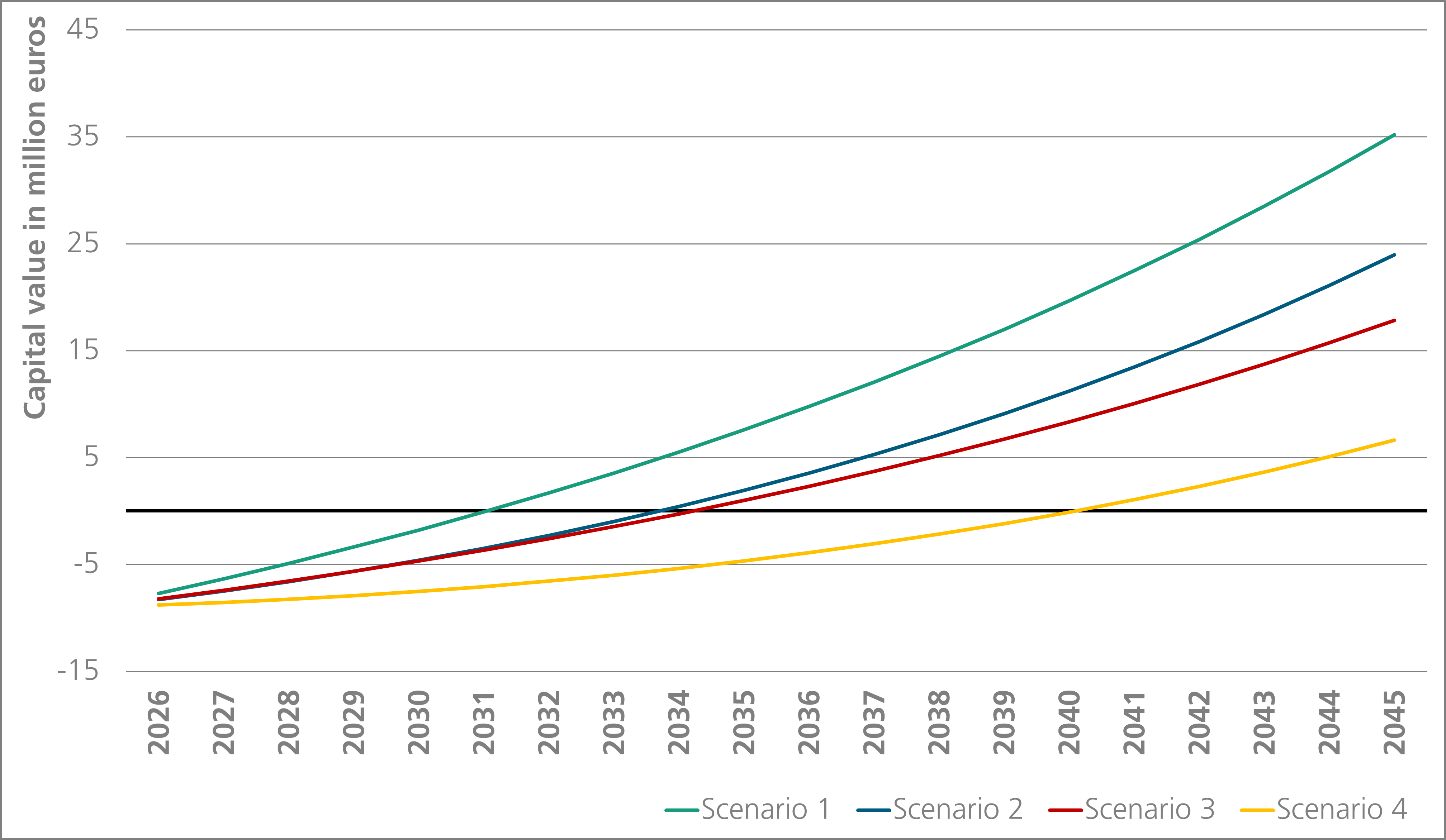
Economic evaluation of CCU technologies using the example of a waste incineration plant


The investments pay off in the long term in all scenarios - but with significant differences in speed and scope:

  • Scenario 1 (low energy prices, high emission costs) is economically the most attractive:
    Amortization from 2031, capital value increases to 35 million euros in 2045
  • Scenario 2 (high energy prices, high emission costs):
    Amortization from 2033, capital value increases to 24 million euros in 2045
  • Scenario 3 (low energy prices, low emission costs):
    Amortization from 2034
    , capital value increases to 18 million euros in 2045
  • Scenario 4 (high energy prices, low emission costs):
    Amortization from 2040
    , capital value increases to 7 million euros in 2045

The economic viability of CO₂ capture depends largely on energy prices and emission costs. The use of CO₂ as a raw material (CCU) offers high financial potential under favorable conditions. It also shows that the use of captured CO₂ as a raw material (CCU) is a more financially advantageous strategy than geological storage (CCS).
 

  • Storage of CO2
  • This means no revenue from the sale of CO₂ as a raw material
  • Assumed transport costs: 16 EUR/t CO₂ (for a transport distance of 400 km)

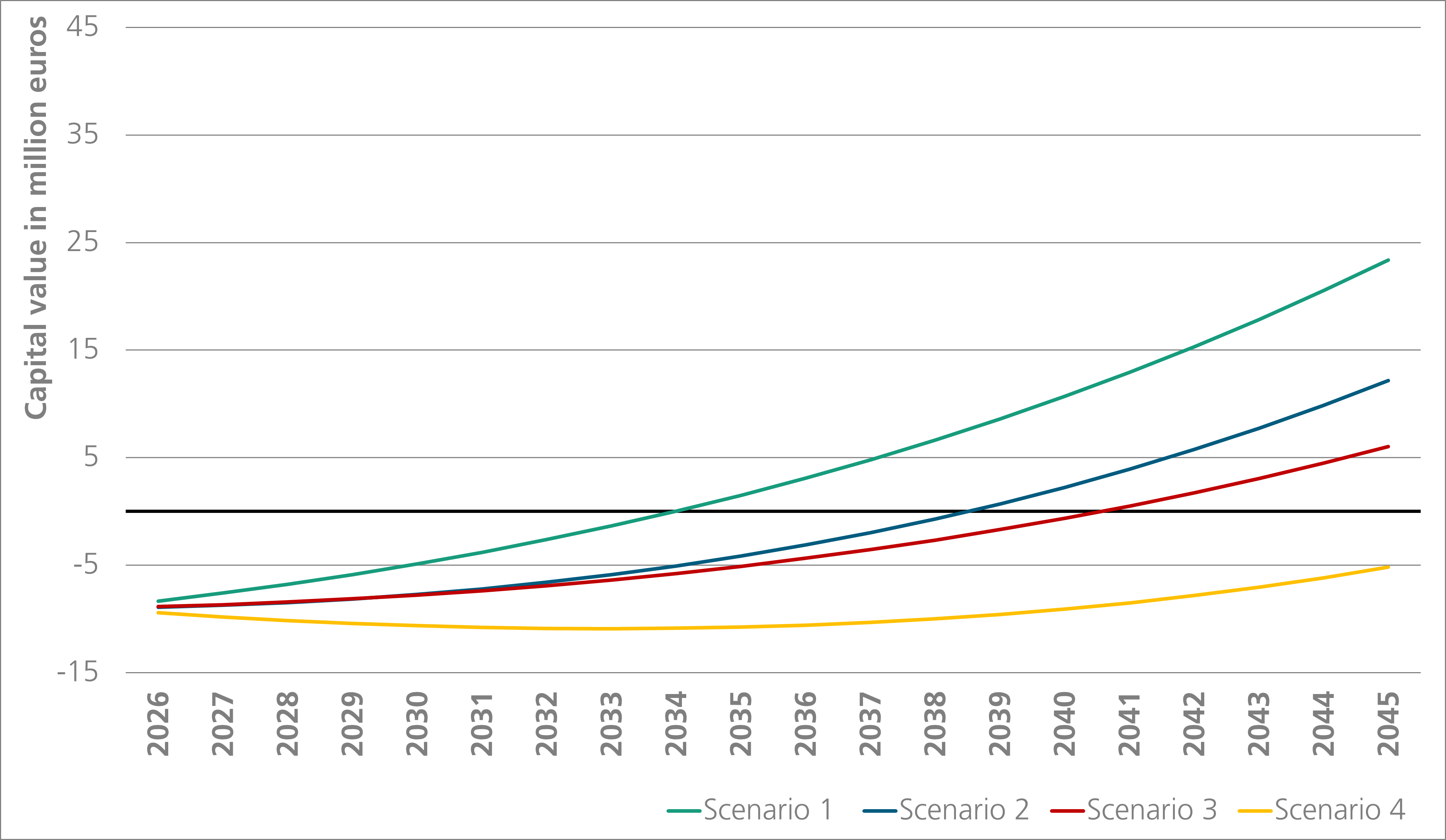
Economic evaluation of CCS technologies using the example of a waste incineration plant


The investments do not pay off in all scenarios and only show a significantly lower level of amortization later on:

  • Scenario 1 (low energy prices, high emission costs) is economically the most attractive:
    Amortization from 2034, capital value increases to 23 million euros in 2045
  • Scenario 2 (high energy prices, high emission costs):
    Amortization from 2038
    , capital value increases to 12 million euros in 2045
  • Scenario 3 (low energy prices, low emission costs):
    Amortization from 2040
    , capital value increases to 6 million euros in 2045
  • Scenario 4 (high energy prices, low emission costs):
    No amortization by 2045
     

Compared to CO₂ utilization (CCU), geological storage (CCS) is significantly less economically attractive. CCS can only be profitable in the long term under very favorable conditions.


CCU: CO2 as a raw material in the chemical industry and for synthetic aviation fuels

In the chemical industry, 85 % of the carbon bound in chemicals and polymers comes from fossil raw materials, while biomass (10 %) and recycling (5 %) only account for smaller proportions. The use of previously captured CO2 represents a promising alternative to fossil raw materials. A key process is the conversion of CO2 with hydrogen to synthesis gas, which is processed into methanol. Methanol serves as the central starting point for the MTO/MTA process, which produces propylene and ethylene - important raw materials for plastics. CO2 can also be used to produce Sustainable Aviation Fuels (SAF). This can be used in many existing aircraft engines without modification.


Prerequisites for the market penetration of CCU/CCS technologies

  • Cost reduction: CCU must become economically competitive
  • Green electricity: renewable energy is essential for many CCU/CCS processes
  • CO₂ infrastructure: Networks are required for the transportation and, if necessary, storage of CO₂
  • Framework conditions: Clear rules, subsidies and customers for CO₂-based products


Services offered

Fraunhofer IKTS offers various tools to help municipal and industrial plant operators comprehensively analyze CO₂-intensive processes, classify them in accordance with legal requirements, and improve them in a sustainable manner:

  • Techno-economic evaluation of technologies and value creation systems
  • Technology-oriented evaluation of market and regulatory framework conditions
  • Life cycle analyses (economic: Life Cycle Costing (LCC); ecological: Life Cycle Assessment (LCA))
  • Development of simulation and optimization models to support operational decision-making processes (e.g. investment decisions)